Philip's Army
You play Philip II of Macedon
Your brother is dead with 4,000 men and enemies sit on every border. Can you buy time to build a new army?
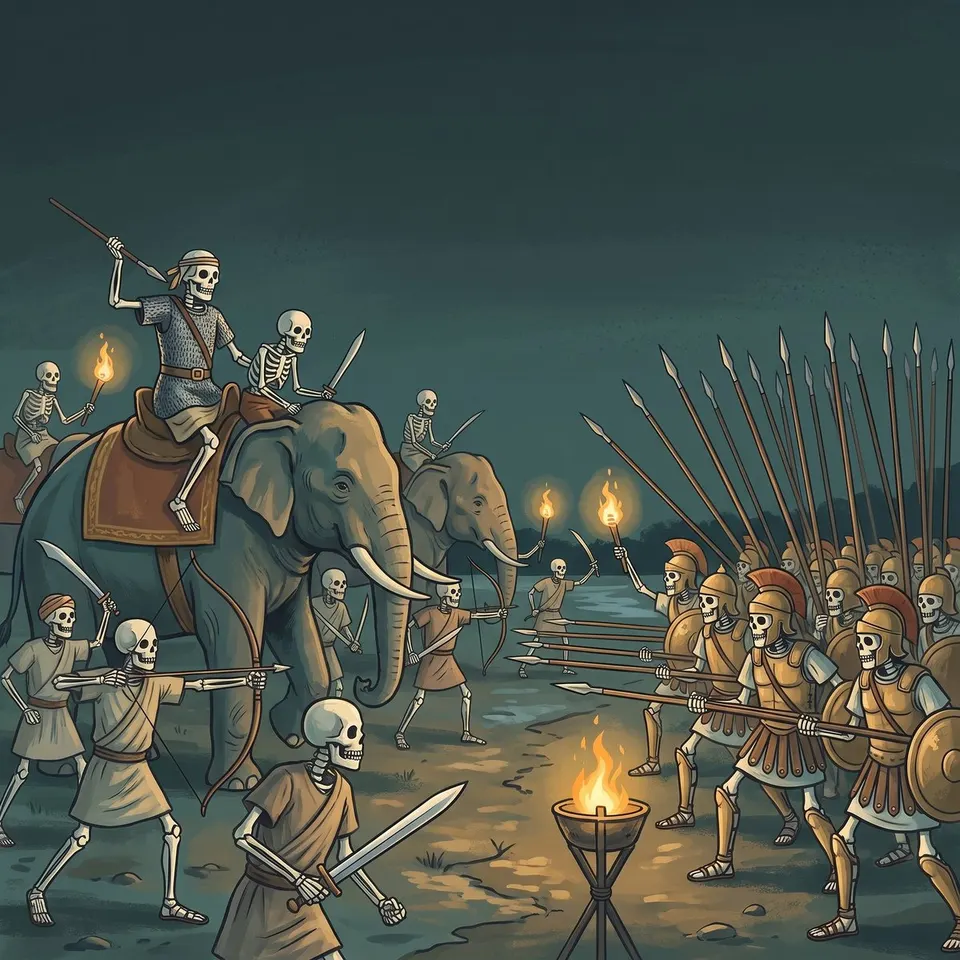
Macedonia, 359 BCE. A small kingdom on the northern edge of the Greek world has just lost its king in battle, and four thousand of its soldiers with him.
Your first call · Athenian soldiers: 3,000
Pull your men out of AmphipolisHold Amphipolis against Athens
Sources
- Diodorus Siculus, Library of History 16.1 to 16.4 (Philip a hostage in Thebes, reared with Epaminondas; the murders of his brothers' reigns; Perdiccas killed by the Illyrians with more than 4,000 Macedonians; the panic; the Paeonians, the Illyrian invasion army, the pretender Pausanias backed by the Thracian king, Athens backing Argaeus with 3,000 hoplites and a fleet under Mantias; the assemblies and speeches, the drills, 'the compact order and the equipment of the phalanx' (16.3.2); withdrawal from Amphipolis; gifts to the Paeonians and the Thracian king; Argaeus at Aegae and his defeat; peace with Athens; Paeonia conquered; Bardylis's offer, Philip's 10,000 foot and 600 horse against 10,000 picked foot and 500 horse, the flank attack, more than 7,000 Illyrians killed, all Macedonian towns returned), 16.8 (Amphipolis taken; the gold mines at Crenides renamed Philippi), Loeb trans. C. L. Sherman
- Diodorus Siculus, Library of History 16.53.3 (Philip 'was wont to declare that it was far more by the use of gold than of arms that he had enlarged his kingdom'), Loeb trans. C. L. Sherman
- Justin, Epitome of Pompeius Trogus 7.5 to 7.6 (Philip a hostage of the Illyrians and then of Thebes, three years in the house of Epaminondas; Perdiccas's infant son; the people make Philip king; 'the poverty of his kingdom, exhausted by a series of wars'; some enemies bought off, others given peace; the Athenians released 'uninjured and without ransom'), 9.8 (Philip died at 47), trans. J. S. Watson (1853)
- Frontinus, Stratagems 4.1.6 (Philip, organizing his first army, forbade carriages and had each man carry flour for thirty days), Loeb trans. C. E. Bennett
- Theophrastus, Enquiry into Plants 3.12.2 (the longest Macedonian sarissa is twelve cubits, about 5.5 metres), trans. A. Hort (1916)