The King's Great Matter
You play Henry VIII
The Pope will not end your marriage. Do you break with Rome?
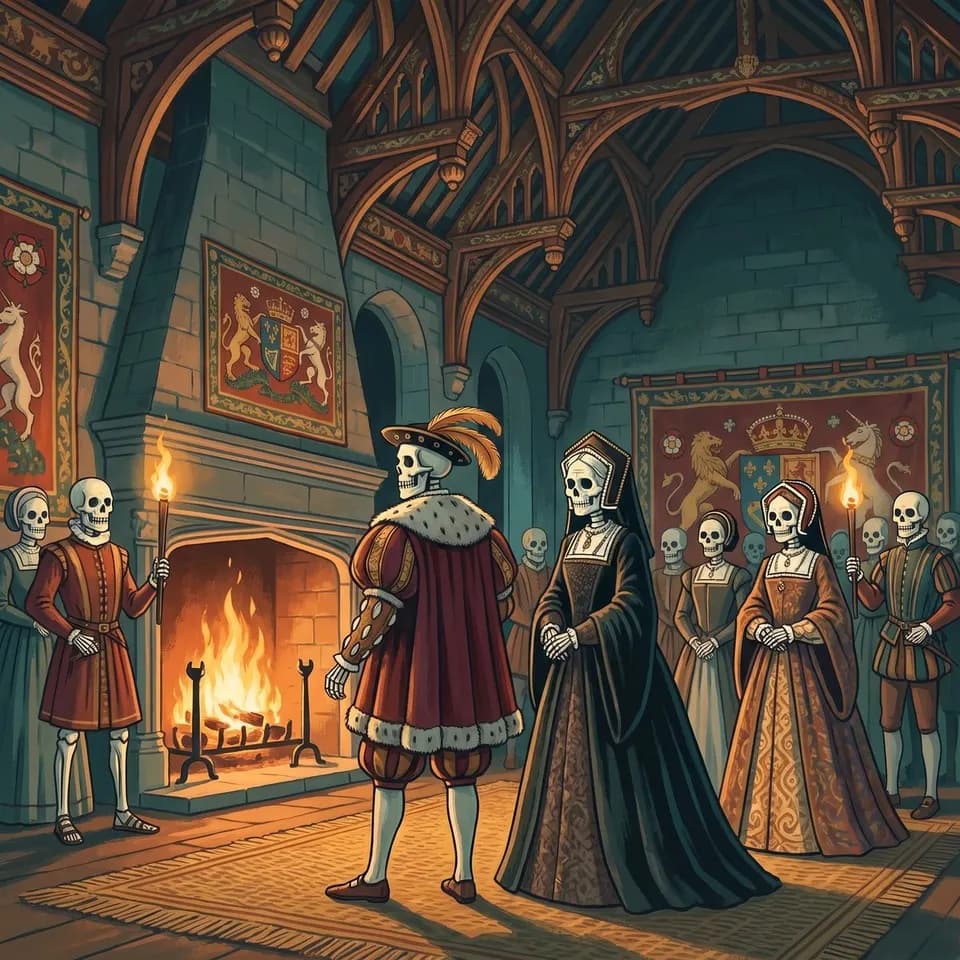
England, 1527. Henry VIII has been married to Catherine of Aragon, a Spanish princess, for eighteen years. They have one living child, a daughter named Mary.
Your first call · The baby: on its way
Marry Anne now, in secretWait for the Pope's ruling
Sources
- George Cavendish, The Life of Cardinal Wolsey, ed. S. W. Singer (Project Gutenberg 54043): the court at Blackfriars; Catherine going about to the king and kneeling at his feet 'in broken English' ('I have been to you a true humble and obedient wife'), leaving and never appearing at any court after; Campeggio: 'I will give no judgment herein until I have made relation unto the pope'; Wolsey arrested of high treason at Cawood in November 1530 and dying at Leicester on the way south; his words to Kingston ('if I had served God as diligently as I have done the king, he would not have given me over in my grey hairs'); Cromwell resolving to 'make or mar'. The same edition prints George Wyatt's Life of Queen Anne Boleigne: Anne 'rejected all his speech of love' and the king 'in the end fell to win her by treaty of marriage'; George Wyatt on Anne's 'witty and graceful speech'
- A. F. Pollard, Henry VIII (1905; Project Gutenberg 20300): the 'doom of childlessness pronounced in the Book of the Law against him who should marry his brother's wife'; Mary Boleyn Henry's mistress before Anne; Clement 'a prisoner in the hands of the Emperor's troops' after the sack of Rome, Catherine 'his master's aunt'; the revocation of the case to Rome in July 1529; the 1531 salvo 'so far as the law of Christ allows'; Parliament prorogued 14 May 1532 and More resigning two days later; 'by the end of January Henry knew that Anne Boleyn was pregnant'; Warham's death in August 1532 and Cranmer's bulls; Dunstable sentence 23 May, coronation 1 June, Elizabeth born 7 September 1533; Clement's sentence of excommunication drawn up 11 July 1533; the title confirmed by Act of Parliament in 1534 and the new treasons; the Pope expediting Cranmer's bulls under the threat of the Act of Annates, 'suspecting, as he must have done, the object for which they were wanted'; the sentence of excommunication drawn up on 11 July 1533, its declaration suspended (note: the bull was eventually dated 30 August 1535)
- The Love Letters of Henry VIII to Anne Boleyn (Project Gutenberg 32155): Anne 'appointed maid of honour to Queen Katherine'; Henry's offer to take her for his 'only mistress'
- Thomas Cranmer to Nicholas Hawkyns, 17 June 1533 (Luminarium transcription): the court at Dunstable 'within four miles unto Amptell, where the said Lady Kateren keepeth her house'; Catherine refusing to appear because her cause was before the Pope; sentence the morrow after Ascension Day; Anne 'married much about St Paul's day last'; 'I myself knew not thereof a fortnight after it was done'; the coronation
- Henry Gee and W. J. Hardy, Documents Illustrative of English Church History (1896), no. XLVIII, The Submission of the Clergy ('agreed to by Convocation on May 15, 1532, and handed to the king on the following day'), and no. L, The Restraint of Appeals, 24 Hen. VIII c. 12 ('this realm of England is an empire')
- R. B. Merriman, Life and Letters of Thomas Cromwell, vol. 1 (1902; Project Gutenberg 49086): Walter Cromwell a brewer, smith and fuller of Putney; Cromwell's legal practice; Pole's account of Cromwell urging Henry to 'declare himself Head of the Church in England'; the Act forbidding appeals to Rome passed before the court at Dunstable
- Letters and Papers, Foreign and Domestic, Henry VIII, vol. 8 (1535), no. 876, Chapuys to Charles V, 16 June 1535: Henry, hearing that Fisher had been made a cardinal, 'declared in anger several times that he would give him another hat, and send the head afterwards to Rome for the Cardinal's hat'; Fisher and More summoned again to swear to the King as Head of the Church or be executed as traitors
- Catholic Encyclopedia (1910), 'Blessed John Fisher': the Queen's chief supporter at the legates' court; in 1531 the addition 'so far as God's law permits' made 'through Fisher's efforts'; sent to the Tower 26 April 1534 for refusing the oath of succession; created cardinal by Paul III in May 1535; Henry forbade the hat to enter England, 'declaring that he would send the head to Rome instead'; beheaded on Tower Hill 22 June 1535, head set on London Bridge
- Catholic Encyclopedia (1912), 'St. Thomas More': resigned the chancellorship in May 1532; indicted 1 July and beheaded on Tower Hill 6 July 1535
- Center for Thomas More Studies, 'I die the king's good servant, and God's first': translation of the Paris newsletter of 4 August 1535, 'qu'il mouroit son bon serviteur et de Dieu premierement'
- Saint John Fisher (catholicism.org): Fisher and More canonized by Pius XI on 19 May 1935
- Encyclopaedia Britannica (1911), 'Fisher, John': 'He was beheaded on Tower Hill on the 22nd of June 1535'; 'His head was exposed on London Bridge'