How a day in Augur works
- Open today's story. A painted chapter of real history: the Ides of March, Blackbeard at Charleston, Anne Boleyn's fall.
- Listen or read, about five minutes. A narrator tells it, and the scenes are painted in Augur's storybook style.
- Take the seat. Make the calls the real person faced, using what you just learned.
- See what really happened. Your verdict against history, then the truth, plainly told.
- Seal it. The story is sealed on your era trail, and your streak grows.
Why it sticks when reading doesn't
You remember what you use. In a well-known memory study, people who had to use what they learned remembered 61% a week later; people who only reread it remembered 40% (Roediger & Karpicke, Psychological Science, 2006). Every story in Augur ends with you deciding, which is the part that makes it stay.
One lesson, start to finish: Salamis
Here is what a single day in Augur actually looks like, using the battle of Salamis in 480 BCE.
The story opens three years earlier in Athens. The city has struck a rich vein of silver, and the citizens expect to share it out. Themistocles, an ambitious politician, argues instead for spending it on a fleet of warships. Most Athenians think the threat is a neighbouring island. Themistocles is thinking about Persia.
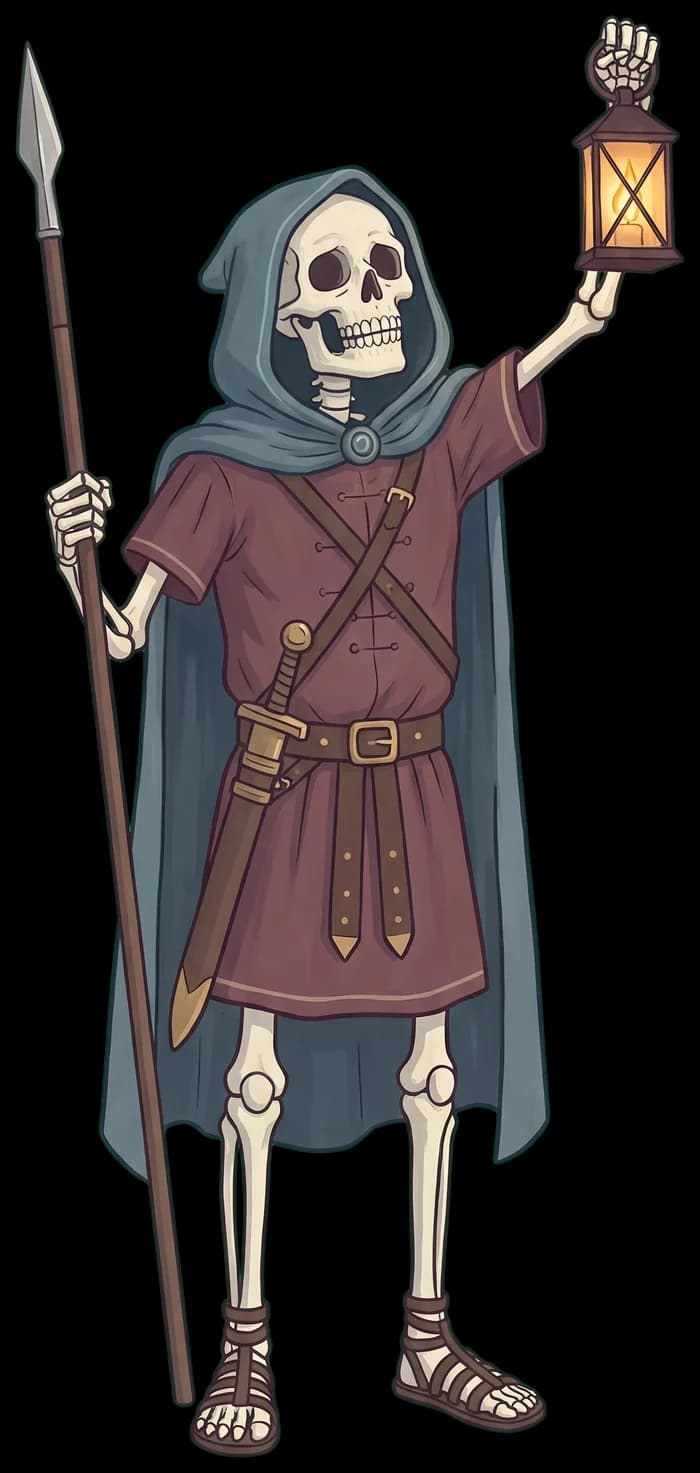
The narrator carries you forward to 480 BCE. A vast Persian army has burned Athens, and the Greek fleet sits in the narrow straits off the island of Salamis, arguing about whether to retreat. Painted scenes show the smoke over the Acropolis and the crowded ships. The augur, Augur's skeleton host, has opinions about the Greek admirals.
Then it's your turn. You take Themistocles's seat. Do you let the fleet sail away to defend the isthmus, or find a way to force the battle here, where the narrow water cancels out the Persian numbers? What message, if any, do you send to the Persian king? You make the calls, then get your verdict and the real story: Themistocles sent a secret message that tricked the Persians into attacking in the straits, and the Greeks won one of the most important sea battles in history.
That's the whole lesson. About five minutes of story, a minute or two of decisions, and you know Salamis for good.
How it compares with other ways to learn history
| Way to learn | Time it asks | What you do | Best for |
|---|---|---|---|
| Books | Hours per book | Read | Depth on one subject |
| Podcasts | An hour or more per episode | Listen | Long commutes and chores |
| Documentaries | An hour or more | Watch | Seeing places and objects |
| Online courses | Weeks, with set lessons | Watch, read, take tests | Structured study and exams |
| Augur | Five minutes a day | Listen or read, then decide | A daily habit that sticks |
None of these replaces the others. Many people use Augur to get the shape of an era, then go deeper with a book or podcast on the part that grabbed them. The difference is that Augur is small enough to do every day, which is what turns a good intention into knowledge that lasts.
What you can learn
Ancient Egypt, Greece and Rome. The Vikings, the crusades, the Mongols and the Templars. Renaissance Italy, the Tudors, the samurai, the golden age of piracy, the Thirty Years' War and World War II. Plus collections like Creepy History, and What If games where you try to rewrite it all.
Is there a Duolingo for history?
That's exactly the gap Augur fills. Here's how it maps:
| What works in Duolingo | How Augur does it for history |
|---|---|
| Short daily sessions | One five-minute story a day |
| A streak and a daily reminder | The same: a streak and a reminder at the time you choose |
| Exercises that make you use it | Decisions where you take the seat of someone who was there |
| A path you work along | An era trail you walk, sealing each story you finish |
| Quick feedback | A verdict on your run, then what really happened |
Who it's for
- Adults who loved one great history teacher, documentary or book, and want more of that feeling.
- People who want something better than scrolling for five minutes a day.
- Anyone who always meant to finally understand Rome, the Tudors or World War II.
Want to compare first? Here are the best history apps for adults, or warm up with our free history quiz.
Questions
Is there an app like Duolingo for history?
Yes. Augur borrows what works about Duolingo (short daily sessions, a streak, steady progress) and applies it to history, with narrated stories where you make real decisions instead of drills.
What is the best history learning app for adults?
For a short daily habit that actually sticks, Augur. If you want free structured courses, Khan Academy; for documentaries, History Hit. See our full comparison of the best history apps.
How long does it take each day?
About five minutes for a story, plus a minute or two for your decisions.
Is the history accurate?
Every story is written from historical sources and fact-checked, and when your choices differ from the real ones, the app tells you what actually happened.
How much does Augur cost?
Augur is subscription-based, and you can cancel anytime.